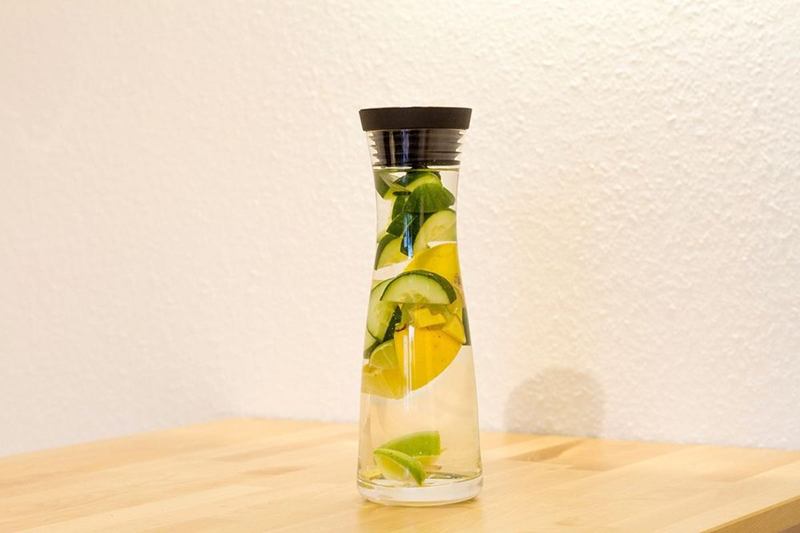
The water carafe is on the table every day, the decanter comes out for celebrations and your favourite vase holds fresh flowers every week. Sooner or later a white ring, a reddish film or a green haze appears – exactly where no hand and no sponge can reach. To clean a carafe properly, what you need most is the right tools and a little patience.
The good news: scrubbing is rarely necessary. Citric acid, uncooked rice, denture tablets and a bottle brush do most of the work. These five methods show how to dissolve each type of deposit and then dry the glass without new marks.
Why carafes and vases turn cloudy
Cloudy glass usually has one of four causes. The most common is limescale: when water stands in a carafe for hours or days, some of it evaporates and leaves minerals behind on the glass. How much depends on water hardness, which varies from commune to commune in Switzerland. On the platform of the Swiss gas and water association you can look up the water hardness where you live by postcode.
In decanters, wine residue builds up: pigments and tannins form a reddish or brownish film. In vases, algae and bacteria grow in standing water, recognisable by a green ring and a rotten smell. The fourth cause is the trickiest: glass corrosion. Frequent dishwasher cycles can attack the surface, and this kind of cloudiness cannot be removed.
| Deposit | Likely cause | What helps |
|---|---|---|
| White ring, milky haze | Limescale from tap water | Let citric acid or vinegar work |
| Reddish or brown film | Wine, tea, cordial | Denture tablet, then rice or brush |
| Green ring, bad smell | Algae and bacteria in flower water | Brush or rice, hot soapy water |
| Haze remains after vinegar | Corrosion from the dishwasher | Cannot be fixed, wash by hand in future |
1. Citric acid or vinegar for the limescale ring
Limescale is a mineral deposit that only acid dissolves. The Swiss consumer protection foundation lists vinegar and citric acid among tried-and-tested household remedies that replace many special products.
- Fill the carafe with lukewarm, not boiling, water.
- Stir in citric acid powder according to the packet or add a good splash of household vinegar.
- Leave for at least an hour, overnight if the ring is thick.
- Empty it, help things along with a bottle brush and rinse thoroughly with clean water.
Vinegar smells stronger, citric acid is odourless. Which acid suits which job is explained in our guide descaling with citric acid or vinegar.
2. Rice or salt: swirl instead of scrub
For deposits that don't come off on their own after soaking, an old household trick works well: put a handful of uncooked rice and some warm water with a splash of vinegar or a drop of washing-up liquid into the carafe, cover the opening with your hand and swirl vigorously. The grains scour the inner wall without a brush having to reach it.
Coarse salt works in a similar way and a little more strongly. For fine crystal and painted glass, stick to rice, as sharp salt crystals can scratch delicate surfaces. Rinse well afterwards so that no grains stay behind in the neck.
3. Denture tablets for wine and tea stains
Denture tablets remove discolouration with the oxygen released as they dissolve. Fill the carafe with warm water, add one or two tablets and leave for a few hours or overnight. Then help things along with the brush or a little rice and rinse very thoroughly until no smell remains.
It is best to rinse a decanter with warm water straight after use, so wine residue has no time to set. Many wine lovers skip washing-up liquid for the decanter, because residue can affect the taste.
4. Clean a carafe with a bottle brush and dry it properly
For everyday care, warm water with a little washing-up liquid and a long, slim bottle brush are enough. Brushes with natural bristles or a soft foam head are gentler than those with metal wire. Rinse with clean water afterwards so no soap film remains.
Whether a carafe is dishwasher-safe is stated on the packaging or by the manufacturer. Even if it is, the water often does not reach the inside of a narrow neck properly. Always wash crystal, lead crystal and painted or gilded glass by hand. Avoid thermal shock – no hot water in cold glass.
Drying decides whether new marks appear. Stand the carafe upside down in a decanter drying stand or in a wide glass so that air can circulate – not flat on a towel, where moisture stays trapped. Polish the outside with a lint-free linen or microfibre cloth.
5. Cleaning a vase: algae and smells
Flower vases need less acid but more hygiene. Empty the water as soon as the flowers have wilted and scrub the vase with hot soapy water and the brush. Rice helps again for narrow vases. A limescale ring at the waterline disappears with citric acid, just as in a carafe.
To prevent algae, change the water every two to three days, remove leaves below the waterline and clean the vase before every new bouquet. Chlorine-based products are not needed.
The most common mistakes
- Boiling water in crystal: the thermal shock can crack fine glass.
- Scouring powder and steel wool: they scratch the surface, and new deposits settle in the scratches.
- Leaving water to stand for days: this is how the limescale ring builds up – empty and rinse the carafe daily.
- Putting it away wet: a closed, damp carafe soon smells musty.
- Mixing products: never combine acid with other cleaners, least of all with chlorine-based ones.
Frequently asked questions
How do I get the limescale ring out of a glass carafe?
Fill the carafe with lukewarm water and citric acid according to the packet, or a splash of vinegar, and leave it for at least an hour, overnight if the deposit is thick. Then help it along with a brush or rice and rinse with clean water.
Does the rice trick really work?
Yes. Uncooked rice with a little water and vinegar or washing-up liquid gently scours the inside when you swirl the carafe hard. It replaces the brush where it cannot reach, but it will not dissolve thick limescale without acid.
Can a carafe go in the dishwasher?
Only if the manufacturer says it is dishwasher-safe. Always wash crystal, lead crystal and painted or gilded glass by hand. Frequent dishwasher cycles can cloud glass permanently.
Why does my carafe get marks again after washing?
Usually water containing dissolved limescale dries inside the glass. Stand the carafe upside down in a stand or wide glass so that it dries quickly with air around it, and polish the outside with a lint-free cloth.

Thanks for your feedback! Feel free to share the guide.
Thanks! What was missing? Drop us a line – we will improve the guide. WhatsApp