Once you've settled into a Swiss flat, sooner or later the question comes up: who is going to help with the cleaning? Colleagues recommend "their" cleaner, while online you find cleaning companies with booking forms and quotes. Both options can work very well. Choosing between a private cleaner or cleaning company is less about who cleans better and more about who carries which responsibilities.
This article compares the five differences that matter most in Switzerland. It's general information, not legal or tax advice. For your individual situation, the authorities linked below and your cantonal compensation office are the right contacts.
Private cleaner or cleaning company: the basic difference
With a private cleaner, you enter into an employment relationship directly, even for just a few hours a month. You decide the tasks, the schedule and the pay, and you take on the obligations that come with being an employer.
With a cleaning company, you buy a service. The company employs the cleaner, pays wages and social contributions, and is your single point of contact if something needs adjusting. You agree on what is cleaned and how often; the company organises the rest.
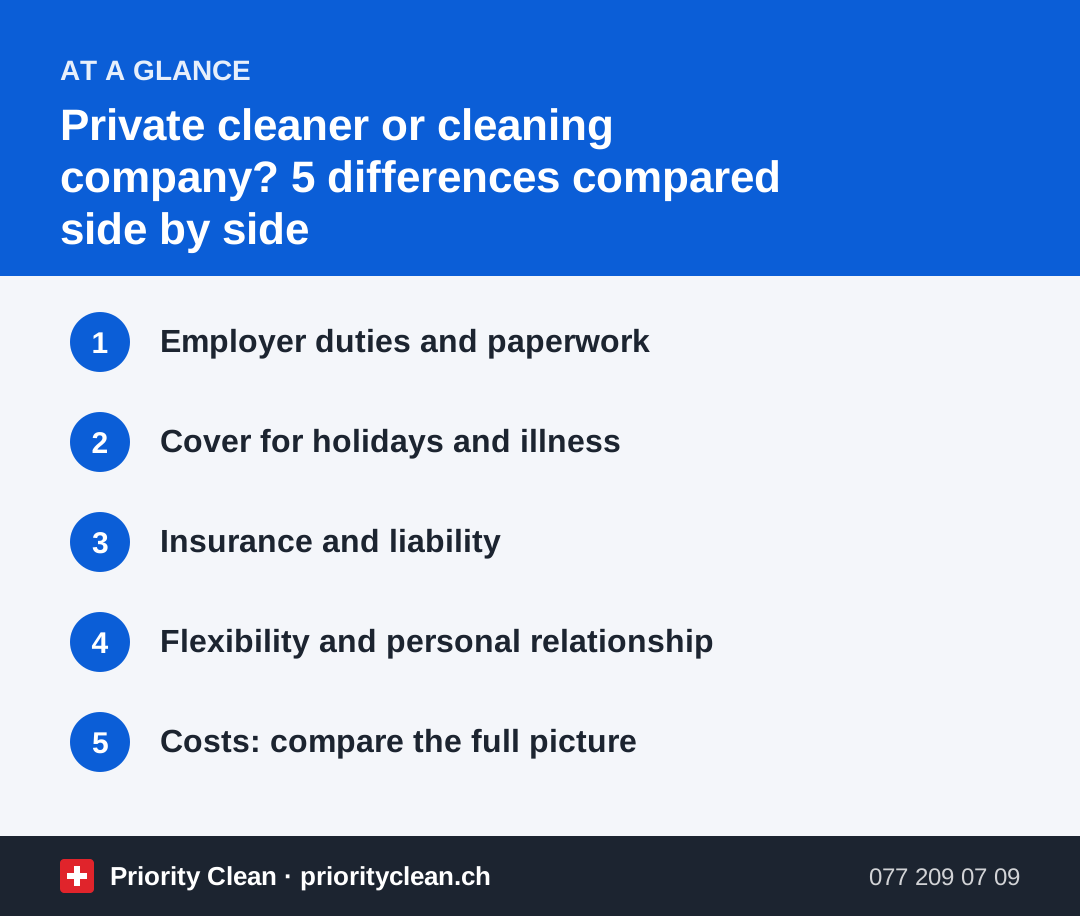
1. Employer duties and paperwork
This is the difference many expats underestimate. According to the AHV leaflet on household staff, social insurance contributions are due even on very small wages, with only a narrow exemption for young people. You also need to register the cleaner with the cantonal compensation office and take out compulsory accident insurance with a licensed insurer. Suva does not cover household work.
SECO's guide for employers explains step by step how private households register household help and settle wages properly, and it provides model employment contracts. Many cantons offer a simplified procedure, which makes it manageable – but it remains your responsibility.
With a company, none of this lands on your desk. Our detailed guide to hiring a cleaning lady privately walks you through every duty if you choose that route.
2. Cover for holidays and illness
A private cleaner is one person. When they are on holiday, ill or leave the country for a few weeks, the cleaning simply doesn't happen, unless you find a replacement yourself. As their employer, you also need to consider holiday entitlement and sick pay according to the contract and the law.
A cleaning company usually has several employees and can organise a replacement if needed. If continuity matters to you, ask how the company handles this. At Priority Clean, we send the same cleaner whenever possible, so you don't have to explain your home again every time.
3. Insurance and liability
Accidents happen: a slip on a wet bathroom floor, a broken vase, a scratched surface. With a private cleaner, you as the employer must have accident insurance in place, and damage to your belongings is often a matter between you and your own household insurance. Check your policy before the first cleaning session.
With a cleaning company, the staff are employed and insured by the company. Ask any company you consider how staff are insured and what happens if something gets damaged. A trustworthy company answers this clearly.
4. Flexibility and personal relationship
Here, a private cleaner often has an advantage. Over time, a strong relationship of trust can grow. Many private cleaners adapt spontaneously: ironing one week, the balcony the next.
Companies work with an agreed scope, which gives you clarity but may feel less flexible. The upside: changes are documented, and you always know what's included. Good companies still adjust the plan when your needs change, for example before guests arrive or after a renovation.
| Aspect | Private cleaner | Cleaning company |
|---|---|---|
| Employer duties | You | The company |
| Accident insurance | You arrange it | Covered by the employer |
| Cover during absence | Organise yourself | Company usually organises |
| Cleaning products | Often yours | Often included |
| Scope | Agreed informally | Agreed in the quote |
| Relationship | Very personal | Same cleaner whenever possible |
5. Costs: compare the full picture
Comparing only the hourly pay of a private cleaner with a company quote is misleading. With a private cleaner, the real cost includes social insurance contributions, accident insurance premiums, holiday pay and your time for admin. Cleaning products and equipment usually come on top.
A company quote covers wages, contributions, insurance, organisation and often products and equipment. A fixed price also avoids surprises when a job takes longer than planned. Our article on what a cleaning company costs in Switzerland explains the price factors in detail.
Which option suits whom?
- A private cleaner can suit you if you want a very personal arrangement, are happy to handle employer duties and have a plan for holidays.
- A cleaning company suits you if you want no paperwork, need reliable cover, prefer a clear scope or need extra services such as windows or a one-off deep clean.
- Mixed solutions also exist: a private cleaner for weekly tasks and a company for the big jobs such as moving out.
Common mistakes when choosing
- Not registering a private cleaner: It's a legal duty, not an optional extra.
- Forgetting accident insurance: Suva doesn't cover household work.
- Agreeing nothing in writing: Scope, schedule and pay should be clear on both sides.
- Choosing on hourly pay alone: Hidden costs and admin time change the picture.
- Handing over keys without a plan: Agree who has keys and how they are returned.
Frequently asked questions
Is it better to hire a private cleaner or a cleaning company in Switzerland?
It depends on your priorities. A private cleaner can offer a personal relationship, but you take on employer duties. A company handles employment, insurance and cover, and you receive a clear scope and price.
Do I have to register a private cleaner in Switzerland?
Yes, as a rule. Social insurance contributions are due even on small wages, and you need compulsory accident insurance. The AHV leaflet on household staff and your cantonal compensation office explain the details.
What happens if a private cleaner has an accident in my home?
As the employer, you must have accident insurance for your cleaner. Without it, you risk being held responsible. With a cleaning company, the company insures its staff.
Can a private cleaner work as self-employed?
Being self-employed in Switzerland requires recognition by the compensation office, and working regularly for a few private households under their instructions usually doesn't qualify. Ask the compensation office if you're unsure.
Thanks for your feedback! Feel free to share the guide.
Thanks! What was missing? Drop us a line – we will improve the guide. WhatsApp