You've decided to get help at home – but how much? Book too little, and the cleaner rushes through and the bathroom never quite gets done. Book too much, and you pay for time you don't need. Working out how many hours of cleaning your household really needs is one of the first questions expats ask when they settle in Switzerland.
There's no universal answer, because every home is different. But five factors let you plan realistically – and explain why many households are better off with a fixed price than with an hourly count.
How many hours of cleaning? Why there's no standard answer
Two flats of the same size can need very different amounts of time. A minimalist 3.5-room flat with one bathroom and one tidy resident is a different job from a family home with two bathrooms, a dog, children's toys everywhere and a home office.
In our daily work, the biggest time differences come not from square metres but from how much stuff is on surfaces, how many "wet rooms" there are, and what state the home is in at the first visit. Here's how to assess your own situation.
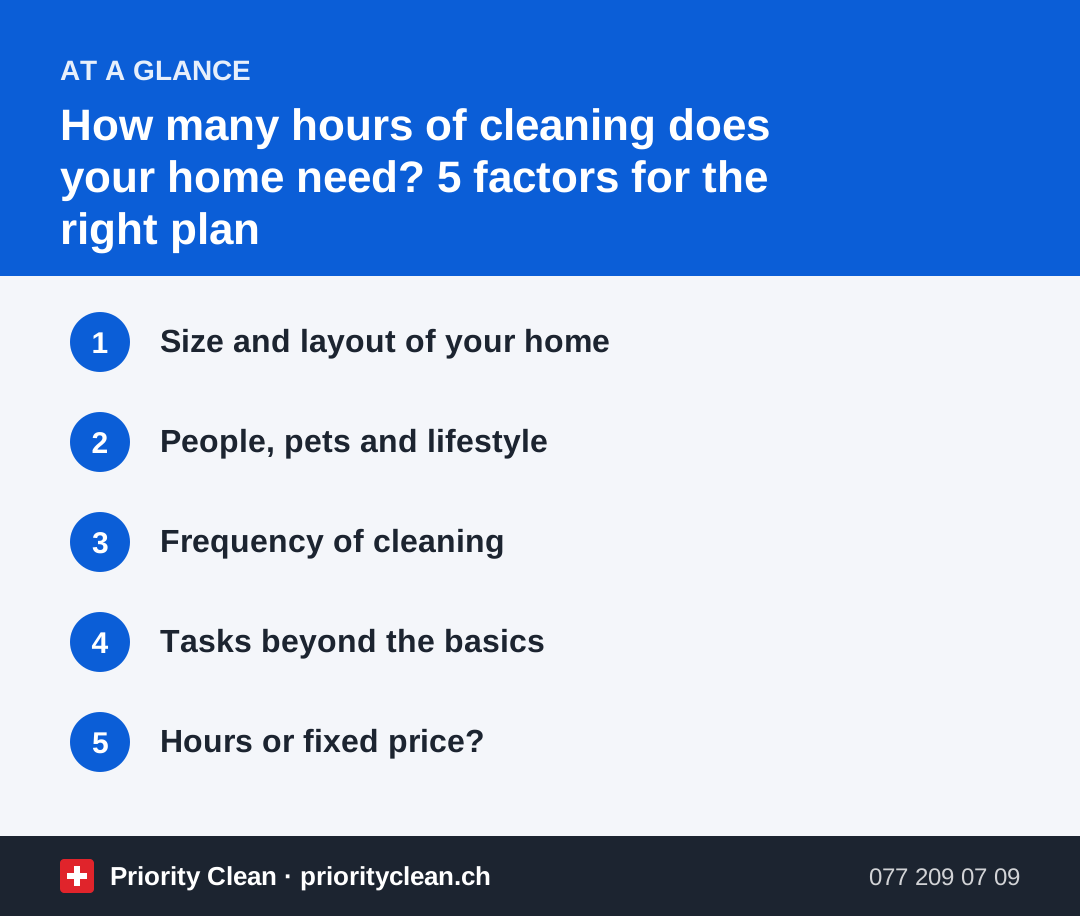
1. Size and layout of your home
The number of rooms is a starting point, but look closer:
- Bathrooms and toilets: Each wet room takes considerably longer than a bedroom – limescale, mirrors, toilet, floor.
- Kitchen: Open-plan kitchens with lots of glossy fronts take longer than closed ones.
- Floors: Parquet, tiles and carpets each need different care.
- Stairs: A maisonette or house with stairs adds time.
- Glass surfaces: Glass doors, shower walls and large mirrors all need extra attention.
In Switzerland, flats are counted in rooms (e.g. 3.5 rooms), where the kitchen and bathroom usually don't count as rooms – so a "3.5-room flat" can be larger than expats expect.
2. People, pets and lifestyle
Every person in a household adds dishes, laundry, bathroom use and general wear.
| Household | Effect on cleaning time |
|---|---|
| Single or couple, working away from home | Lower |
| Home office | Moderate – more kitchen and bathroom use |
| Young children | Higher – fingerprints, crumbs, toys |
| Dogs or cats | Higher – hair on floors and upholstery |
| Frequent guests | Higher – kitchen and guest toilet |
Pet hair alone can add considerable vacuuming time. Our guide on removing dog hair has tips for in between visits.
3. Frequency of cleaning
This is the factor people most often underestimate. Dirt that stays longer takes longer to remove.
- Weekly: Each visit is mostly maintenance – limescale and grease never build up.
- Fortnightly: Visits need to be somewhat longer to catch up.
- Monthly: Each visit is closer to a deep clean – and takes correspondingly longer.
In practice, weekly or fortnightly visits often need less total time per month than monthly ones would suggest, because nothing gets a chance to become stubborn.
4. Tasks beyond the basics
Standard home cleaning usually covers dusting, vacuuming, mopping, kitchen and bathroom. Everything else should be discussed upfront:
- Changing bed linen.
- Laundry and ironing.
- Cleaning inside the fridge or oven.
- Windows, frames and blinds.
- Balcony or terrace.
- Tidying before cleaning.
A simple way to plan: list your must-haves for every visit and your "every now and then" tasks, and rotate the latter.
5. Hours or fixed price?
Hourly billing looks simple, but it has drawbacks: you never quite know the final cost, and the conversation tends to revolve around time rather than results.
With a fixed price, the scope is agreed based on your home and your tasks. You know the cost in advance, and the focus is on the result. At Priority Clean, we calculate a fixed price after seeing a few photos of your home – you receive a quote within 24 hours.
Common mistakes when planning cleaning hours
- Planning only by square metres: Bathrooms, pets and clutter change everything.
- Choosing a monthly rhythm to save money: Each visit then takes much longer.
- Not mentioning extra tasks: Ironing or windows eat into the time for basic cleaning.
- Not tidying before visits: Cleaners spend time moving things instead of cleaning.
- Skipping the first deep clean: Regular visits then spend months catching up.
Frequently asked questions
How many hours a week do I need a cleaner for?
It depends on the size of your home, the number of bathrooms, people and pets, and which tasks you want done. A small, tidy flat needs far less time than a family home with pets. Sending photos for a quote is the quickest way to get a realistic estimate.
Is weekly or fortnightly cleaning better?
Weekly visits keep dirt from building up and are mostly maintenance. Fortnightly visits work well for smaller households, but each visit needs a bit more time.
What does a regular cleaner usually do?
Typically dusting, vacuuming, mopping floors, cleaning the kitchen and bathrooms and emptying bins. Extras such as ironing, windows or the inside of the oven should be agreed separately.
Do I have to register a private cleaner in Switzerland?
Yes. If you employ a cleaner directly, you are generally required to pay social insurance contributions and arrange accident insurance. With a cleaning company, the company takes care of this for its staff.
Thanks for your feedback! Feel free to share the guide.
Thanks! What was missing? Drop us a line – we will improve the guide. WhatsApp