You hear it at night: a quiet hiss from the bathroom, or a thin film of water that keeps running down the inside of the toilet bowl. In many Swiss regions the tap water is hard, and over time limescale settles on the flush valve and its rubber seal until the cistern no longer closes properly. The good news: in many cases you can descale the toilet cistern yourself in an evening, with citric acid and a little patience.
This guide shows you how to find the cause, remove the limescale safely and decide when it's time to call the property management or a plumber instead.
Why Swiss toilet cisterns keep running
Hard water leaves calcium deposits wherever it stands or evaporates. Inside a cistern, that means the seat of the flush valve, the rubber seal and the small float mechanism. Once a crust forms, the seal no longer sits flat and water trickles into the bowl, so the cistern keeps refilling. You can check how hard the water is where you live by postcode on trinkwasser.ch.
A quick word on Swiss bathrooms for newcomers: many modern flats have a concealed cistern built into the wall, and you only see the flush plate with a large and a small button. Older buildings often have an exposed ceramic or plastic cistern above or behind the toilet. The principle is the same; only access differs.
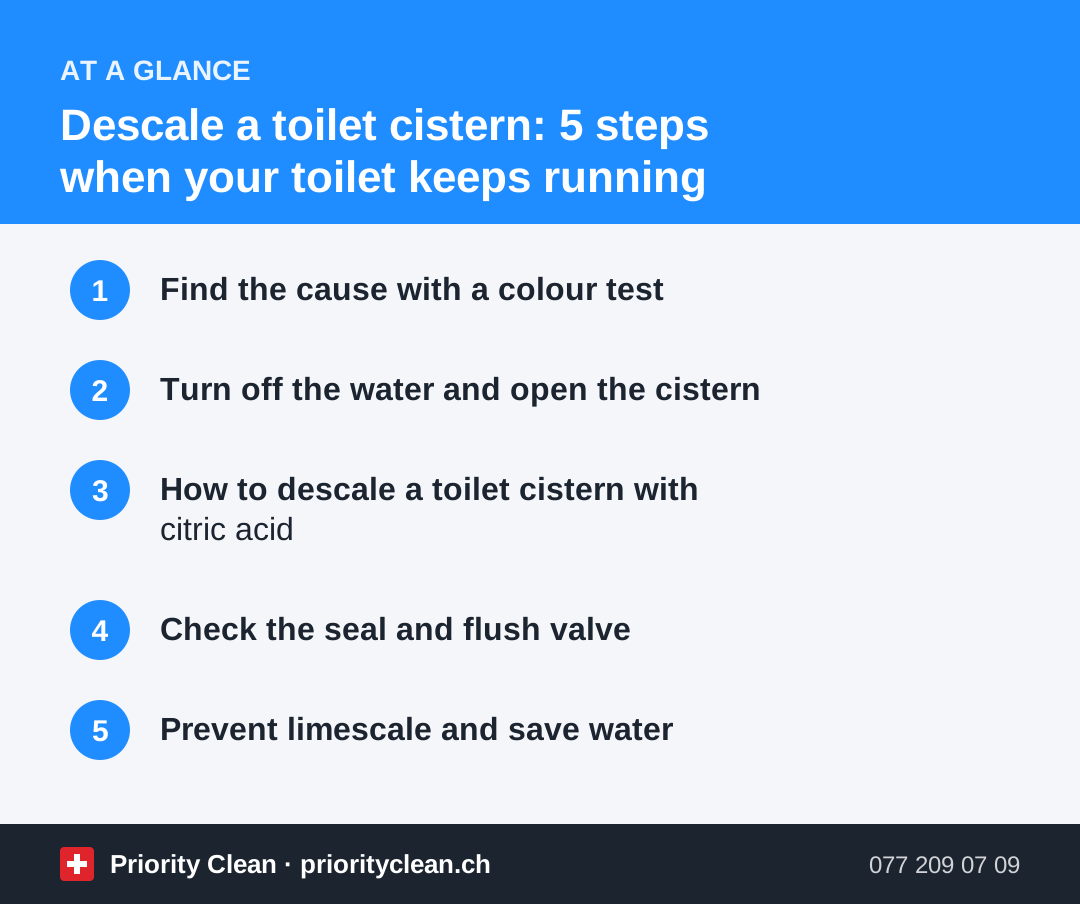
1. Find the cause with a colour test
Before you descale, make sure you're treating the right problem.
- Put a few drops of food colouring into the cistern water (remove the flush plate or cistern lid first).
- Don't flush for 20–30 minutes.
- If coloured water appears in the bowl, the flush valve or its seal is leaking.
- If the bowl stays clear but you still hear water, the fill valve may not be shutting off, or the float is set too high.
2. Turn off the water and open the cistern
- Close the small stop valve (angle valve) on the supply pipe, usually next to or behind the toilet or behind the flush plate.
- Flush once to empty the cistern.
- For a concealed cistern, remove the flush plate: most can be unclipped by hand or lifted upwards. Behind it you'll see the flush valve and the fill valve through a service opening.
- Take a photo of everything before you touch anything. It makes reassembly much easier.
On many systems, the flush valve can be lifted out without tools. If you can't see how it comes out, stop here rather than forcing anything.
3. How to descale a toilet cistern with citric acid
Citric acid is odourless and works well on limescale, and it's our first choice for cisterns in everyday cleaning work.
- Dissolve 3–4 tablespoons of citric acid powder in about a litre of cold or lukewarm water. Hot water can cause residues.
- With the water supply still closed, pour the solution into the empty cistern, or soak removable parts in a bucket with the solution.
- Leave it for one to two hours. Don't leave it standing for days; long exposure isn't good for rubber parts.
- Loosen remaining deposits with an old toothbrush or soft sponge, never with a knife or wire brush.
- Reopen the water supply and flush several times to rinse thoroughly.
Always check the manufacturer's instructions for your cistern first. Some recommend specific descalers or advise against certain products.
4. Check the seal and flush valve
Descaling alone won't help if the rubber seal is worn out.
- Clean the seal: Wipe it with a cloth soaked in the citric acid solution, then rinse.
- Inspect it: Is it cracked, hard, flattened or deformed? Then it no longer closes tightly.
- Check the valve seat: The surface the seal presses on must be smooth and free of crust.
- Test the float: It should move freely and shut off the water at the marked level.
Worn seals are inexpensive and usually available in sanitary shops or DIY stores. Take the old part with you, or a photo of the model label inside the cistern, so you get the right size.
5. Prevent limescale and save water
- Use the small flush button whenever it's enough: less water, less limescale.
- Descale regularly: In hard-water areas, a short citric acid treatment every few months keeps crusts from forming.
- Avoid in-cistern blocks unless your cistern's manufacturer approves them; some can affect seals.
- Keep an ear out: A cistern that hisses or refills on its own is an early warning sign.
- Clean the bowl as well: Limescale in the cistern often comes with limescale and scale in the bowl. Our guide to removing urine scale from a toilet covers that part.
Tenant or landlord: who fixes it?
According to Art. 259 of the Code of Obligations, tenants take care of defects that can be remedied by minor cleaning or small repairs as part of normal maintenance. Descaling and cleaning a cistern generally falls into that category. A defective fill valve, a leak inside the wall or a broken mechanism is a different matter: report it to the property management in writing. Your lease and the local practice decide the details.
Common mistakes
- Using hot descaling solution: It doesn't work faster and can leave residues.
- Scraping with metal tools: Scratches on the valve seat create new leaks.
- Forcing parts of a concealed cistern: Clips break easily. If something won't move, ask a professional.
- Leaving acid in overnight or for days: Rubber seals can become brittle.
- Mixing products: Descaler plus chlorine cleaner is dangerous.
Frequently asked questions
How do I descale a toilet cistern without removing parts?
Close the water supply, flush to empty the cistern, pour in a citric acid solution made with cold water and leave it for one to two hours. Then reopen the supply and flush several times to rinse.
Why does my toilet cistern keep running after flushing?
Most often limescale or a worn seal stops the flush valve from closing tightly. Less often, the fill valve doesn't shut off or the float is set too high. A colour test in the cistern shows which part is leaking.
Can I use vinegar in a toilet cistern?
Vinegar also dissolves limescale, but it smells and can be harder on rubber parts with frequent use. Citric acid is gentler and odourless. Always check the manufacturer's instructions first.
Can I put descaling tablets in a concealed cistern?
Only if the manufacturer of your cistern allows it. Some tablets and blocks can attack seals or leave residues on the mechanism, which may cause new leaks.
Thanks for your feedback! Feel free to share the guide.
Thanks! What was missing? Drop us a line – we will improve the guide. WhatsApp