You've bought a flat in Switzerland – and with it, a share of the stairwell, the entrance, the bin area and the garden path. In a condominium (Stockwerkeigentum / propriété par étages / proprietà per piani), all owners are jointly responsible for these common parts. Sooner or later every community has to decide: who cleans, who takes care of the bins, and do we need a condominium caretaker?
Many expat owners are surprised how much of this is left to the owners themselves. This guide walks you through five steps to organise it clearly. It gives general information only – your community's regulations and resolutions always take priority.
How condominium caretaker costs are shared
In a condominium, the stairwell, facade, roof and other common parts belong to all owners together. The Swiss homeowners' association HEV explains that owners share maintenance and operating costs such as heating, water, caretaking and garden care according to their share.
The legal basis is Art. 712h of the Swiss Civil Code: owners contribute to common charges and administration costs in proportion to their value quotas, unless the regulations provide otherwise. Cleaning and caretaking are typically part of these common charges.
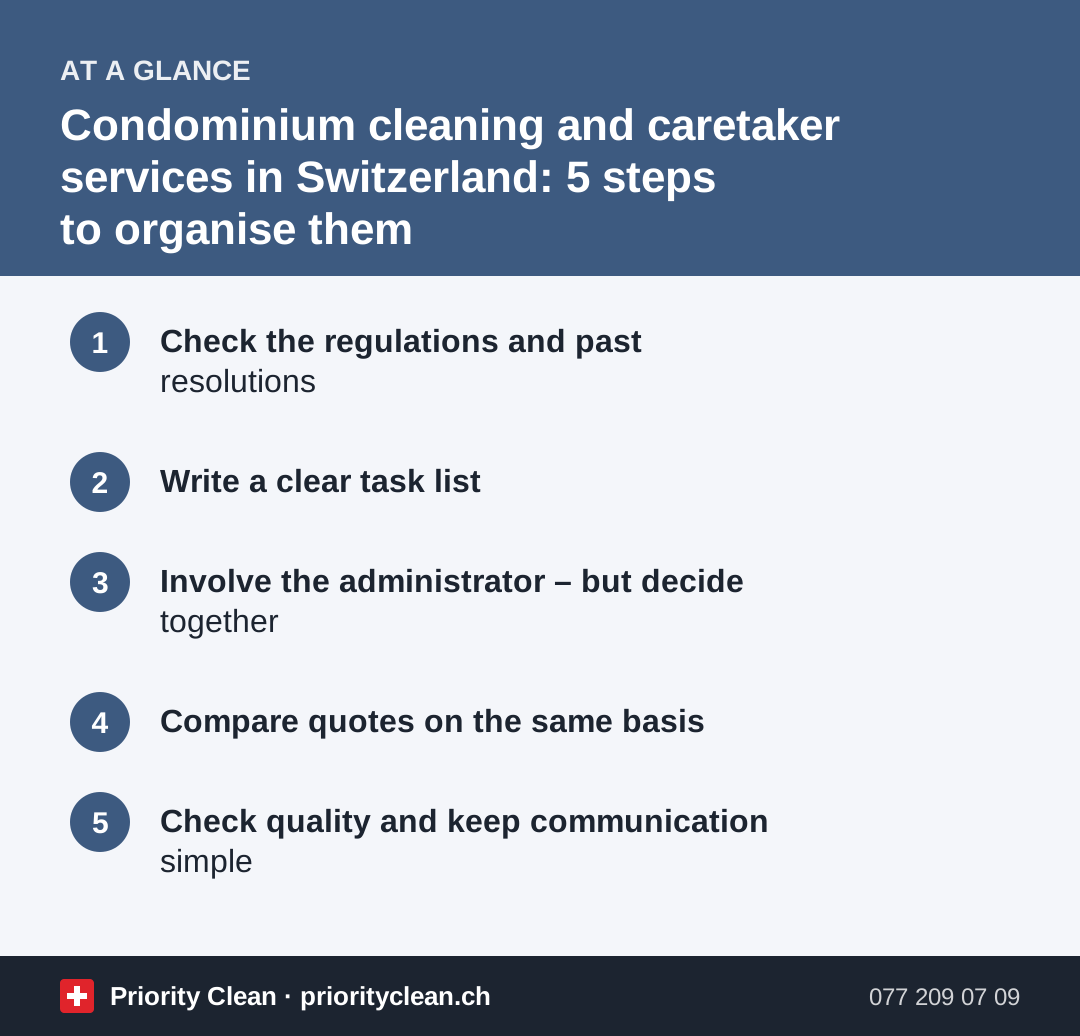
1. Check the regulations and past resolutions
Before organising anything new, find out what already applies.
- Read the condominium regulations (Reglement) – they may define how common areas are maintained and how decisions are made.
- Check the house rules, if the community has any, for rules on the stairwell, bins and storage.
- Ask the administrator for minutes of past owners' meetings – earlier resolutions on cleaning contracts may still be valid.
- Clarify which majority is needed to award or change a cleaning or caretaking contract.
2. Write a clear task list
A task list (Pflichtenheft / cahier des charges) describes what needs to be done, where and how often. It is the most useful document in the whole process.
| Area | Typical tasks | Possible frequency |
|---|---|---|
| Stairwell and landings | Sweep, mop, wipe handrails | Weekly |
| Entrance | Glass doors, letterboxes, doormats | Weekly |
| Lift | Floor, walls, mirror, buttons | Weekly |
| Cellar and laundry room corridors | Sweep, remove cobwebs | Monthly |
| Windows in common areas | Inside and outside | Once or twice a year |
| Exterior | Entrance area, paths, bin area | By agreement |
| Waste | Put containers out and back on collection days | By collection calendar |
Also define what is not included, such as winter services, garden work or technical maintenance – these often need separate providers.
3. Involve the administrator – but decide together
In most condominiums, a professional administrator (Verwaltung) handles day-to-day management. They can:
- Collect and compare quotes.
- Prepare contracts for the owners' meeting.
- Act as the contact person for the cleaning company.
- Handle invoices and allocate costs according to value quotas.
In smaller communities without an administrator, one owner often takes on this role. Make sure responsibilities are written down, so nothing depends on one person's memory.
4. Compare quotes on the same basis
Send the same task list to several providers and ask for quotes. When comparing, look at more than the total:
- Scope: Does each quote cover all tasks and frequencies on the list?
- Staff: Are cleaners employed and insured? Is there a regular team?
- Safety: Employers in building cleaning must consider occupational safety – Suva's checklist for building cleaning covers hazardous substances, slippery floors and ladders.
- Reachability: How quickly does the provider respond to issues?
- Flexibility: Can tasks be adapted, for example after a renovation?
- Contract terms: Notice periods and trial periods.
A fixed price for a clearly defined scope makes budgeting easier for the community.
5. Check quality and keep communication simple
Even the best contract needs follow-up.
- Agree on a single contact person on each side.
- Use a simple channel for feedback, such as email or a messaging group with the administrator.
- Review the service once a year at the owners' meeting.
Common mistakes in condominium cleaning
- No written task list: Every owner expects something different.
- Choosing only on price: Low quotes often cover fewer tasks.
- Unclear responsibility for winter services: Snow and ice need their own arrangement.
- Owners giving direct instructions to cleaners: Leads to conflicting expectations.
- Never reviewing the contract: Needs change over the years.
For tenants in rented buildings, the rules are different – see our guide on who is responsible for stairwell cleaning. And for the colder months, our tips on safe stairwells in winter help.
Frequently asked questions
Who pays for cleaning in a Swiss condominium?
All owners together, usually from the common budget. Costs are generally shared according to value quotas under the Civil Code, unless the regulations say otherwise.
Does a condominium need a caretaker?
Not necessarily. Smaller communities often combine a cleaning company with a few owner volunteers, while larger buildings usually benefit from a caretaker or a provider that covers cleaning and light caretaking.
What should a caretaker task list include?
Areas, tasks, frequencies and exclusions – for example stairwell, entrance, lift, cellar corridors, windows in common areas, bins and exterior areas.
Who decides on the cleaning company in a condominium?
The owners, usually at the owners' meeting according to the regulations. The administrator often prepares the quotes and manages the contract.
Thanks for your feedback! Feel free to share the guide.
Thanks! What was missing? Drop us a line – we will improve the guide. WhatsApp