There is a bin under every desk and three more in the staff kitchen, yet in the evening a lot still ends up in the same bag. Office recycling rarely fails for lack of goodwill – it fails because the bins are unclear, the signs are missing and nobody knows who takes what where.
Yet Switzerland has a well-developed system: paper, cardboard, PET, aluminium, glass, batteries and electrical appliances each have their own collection route. Five rules help turn that into a routine that works even in a busy office.
Why office recycling often doesn't work
Most offices don't have a knowledge problem, they have an organisation problem. Typical stumbling blocks:
- Too many bins in the wrong place: under the desk, everything goes into whichever bin is nearest.
- Vague labels: "Recyclables" doesn't tell anyone whether yoghurt pots, coffee capsules or till receipts belong there.
- No responsibility: nobody feels in charge of emptying full bins or taking batteries back.
- Mixed bags: if a paper bin is full of food scraps, the cleaning team often has no choice but the rubbish bag.
Swiss Recycle offers a good overview of what is collected where in Switzerland and recommends also checking your commune's waste calendar. The table shows the most common fractions in an office:
| Fraction | Typical in the office | Where it goes |
|---|---|---|
| Paper | Printouts, notes, magazines | Paper collection, bundled or in a container |
| Cardboard | Packaging, shipping boxes | Cardboard collection, folded flat |
| PET drinks bottles | Water and soft drink bottles | PET collection point in shops |
| Aluminium and tin | Drinks cans, lids, foil | Aluminium and metal collection |
| Glass | Bottles, jam jars | Glass collection, sorted by colour |
| Batteries | Mice, remote controls, headsets | Collection box in shops |
| Electrical appliances | Keyboards, cables, kettles | Take-back by specialist retailers |
| General waste | Dirty packaging, till receipts | Official rubbish bag as per commune |
1. First look at what you actually throw away
Before ordering bins, watch for a week which waste builds up and in what quantities. An architecture practice produces lots of paper and cardboard; an agency where people lunch at their desks produces more PET, aluminium and food scraps. Ask the cleaning team too: they know best which bins overflow.
Also check with your commune or property management how business waste is handled at your location. Depending on the place and the volume, businesses either use the municipal collection with charged rubbish bags or hire a private waste contractor. That determines which fractions you collect in the building and who picks them up.
2. Central stations instead of a bin under every desk
A simple principle has proven itself: at the workstation, at most a tray for waste paper and a small bin for general waste – everything else goes to central stations.
- Staff kitchen: PET, aluminium, glass, general waste and, if your commune collects organic waste, a bin for food scraps.
- By the printer: a large paper box and a spot for empty toner cartridges.
- At the entrance or reception: a collection box for batteries and a shelf for broken small appliances.
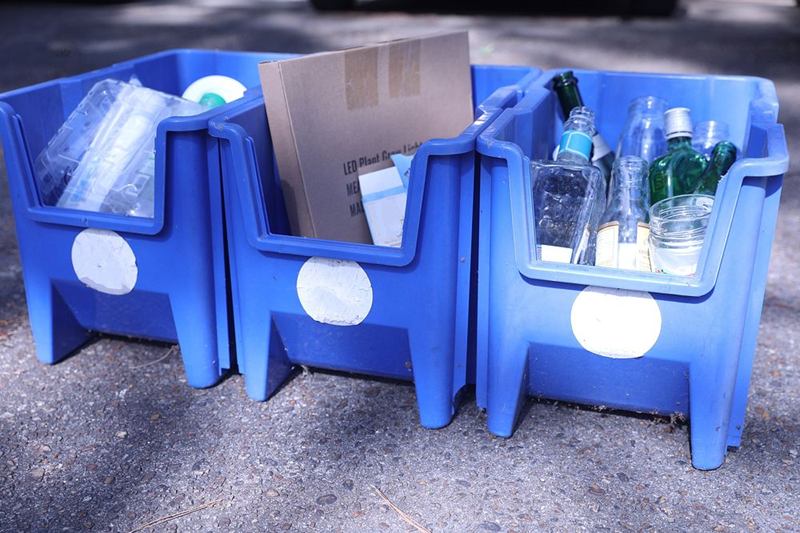
Choose recycling bins with lids and use the same colour for each fraction on every floor. Once people know blue always means paper, they sort without thinking. For organising the coffee machine and fridge, read our rules for the office kitchen.
3. Label clearly and in several languages
A good recycling sign answers three questions: what goes in? What doesn't? Who empties the bin? Keep it short and use pictograms. Many Swiss offices work in German, French, Italian and English – bilingual signs or pure pictograms prevent misunderstandings.
Also name the typical mistakes: coated coffee cups don't go in the paper, plastic trays don't go in the PET and greasy pizza boxes don't go in the cardboard. Update the signs whenever the collection changes.
4. Handle special cases: batteries, appliances, files and capsules
Some types of waste have their own rules, and this is where most office mistakes happen.
- Batteries: according to the Federal Office for the Environment (FOEN), consumers are obliged to return used batteries, and all points of sale take them back free of charge, even without a purchase. All battery types count as hazardous waste. Set up a collection box and take it back regularly.
- Electrical and electronic appliances: they don't belong in the rubbish bag. Retailers, manufacturers and importers must take back appliances of the kind they sell free of charge, even without a new purchase. Wipe the data from computers, phones and printers first, or have your IT provider do it.
- Confidential documents: personnel data and client files shouldn't go straight into the waste paper. Our guide disposing of documents explains how to destroy them securely.
- Toner cartridges: many suppliers take empty cartridges back. Ask yours.
- Coffee capsules: depending on the system, they are taken back via the points of sale or go in the general waste. Check what applies to your capsules.
5. Involve the cleaning team and name responsible people
The best office recycling scheme is useless if everything gets mixed up again when the bins are emptied. So decide:
- Who empties what? The cleaning team empties general waste, paper and the kitchen according to plan; an internal contact person takes back batteries, appliances and toner.
- Where exactly? Describe which containers in the cellar or courtyard each fraction goes into.
- How often? Food scraps daily in summer, paper and PET as needed, cardboard before collection day.
- What happens with wrongly sorted waste? If a bin is heavily contaminated, the cleaning team may dispose of it as general waste and report it to the contact person.
Put these points in writing, ideally in the cleaning specification. That makes it clear what is included in the agreed price.
Common mistakes
- Too many fractions at once: start with the large volumes and add others later.
- Signs without examples: "Recyclables" is too abstract – show concrete items.
- Batteries in the drawer: old batteries pile up for years. A box with a fixed return date helps.
- Handing in devices without wiping the data: a security risk that is easy to avoid.
- Cleaning team not informed: without instructions, separated waste ends up in the same container.
Frequently asked questions
Does an office have to separate its waste?
Batteries and electrical appliances must be returned and don't belong in the rubbish. For all other waste, your commune's rules and services apply. Ask the commune or your property management how business waste is collected at your location.
How many recycling bins does a small office need?
For a small team, one station with paper, PET, aluminium and general waste in the kitchen plus a paper box by the printer is often enough. Collect batteries and old devices in a small box and take them back regularly.
Where do empty coffee capsules go?
That depends on the capsule system. Some are taken back via points of sale, others go in the general waste. Check the manufacturer's information and let your team know with a sign by the coffee machine.
Is the cleaning company responsible for office recycling?
The cleaning team empties the bins and takes each fraction to the right container – provided it was collected separately in the first place. The actual sorting happens at the workstation. Set out the tasks in the cleaning contract.
Thanks for your feedback! Feel free to share the guide.
Thanks! What was missing? Drop us a line – we will improve the guide. WhatsApp