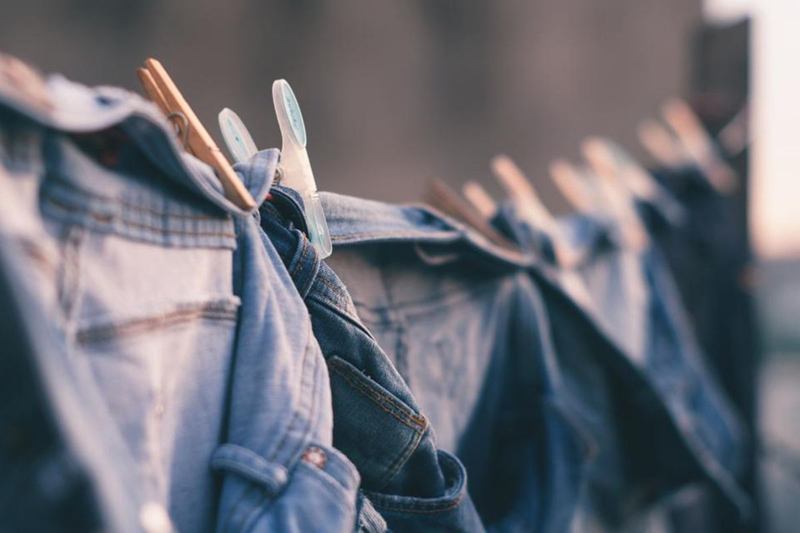
Few items of clothing are worn as often as a pair of jeans. So they end up in the machine often too – and that is exactly what wears them out. After a few months the deep blue has faded, pale patches show at the knees, and the stretch pair no longer fits quite as well. If you want to know how to wash jeans without them fading or shrinking, stick to a simple formula: less often, cooler and inside out.
The five rules below apply to classic cotton denim as well as to stretch models. Unwashed raw denim gets its own advice at the end.
Why jeans fade and shrink
Classic denim is a sturdy cotton twill in which usually only the lengthwise threads are dyed with indigo. This dye sits mainly on the surface of the fibre. Every bit of friction – while you wear it and in the drum – rubs a little colour away. That's why denim fades first at the knees, seams and edges.
Shrinking has other causes: cotton swells in water and contracts again with heat. Stretch denim also contains elastane, which doesn't cope well with heat. After hot cycles or the tumble dryer, it loses its elasticity – and the trousers bag at the knees.
| Problem | Common cause |
|---|---|
| Colour fades evenly | Washed too often and too hot, heavy-duty detergent with bleach |
| Pale streaks along seams | Not turned inside out, drum too full |
| Trousers too short or tight | High temperature, tumble dryer |
| Baggy knees, stretch gone | Heat damages the elastane |
| Blue marks on other laundry | New denim washed with light-coloured items |
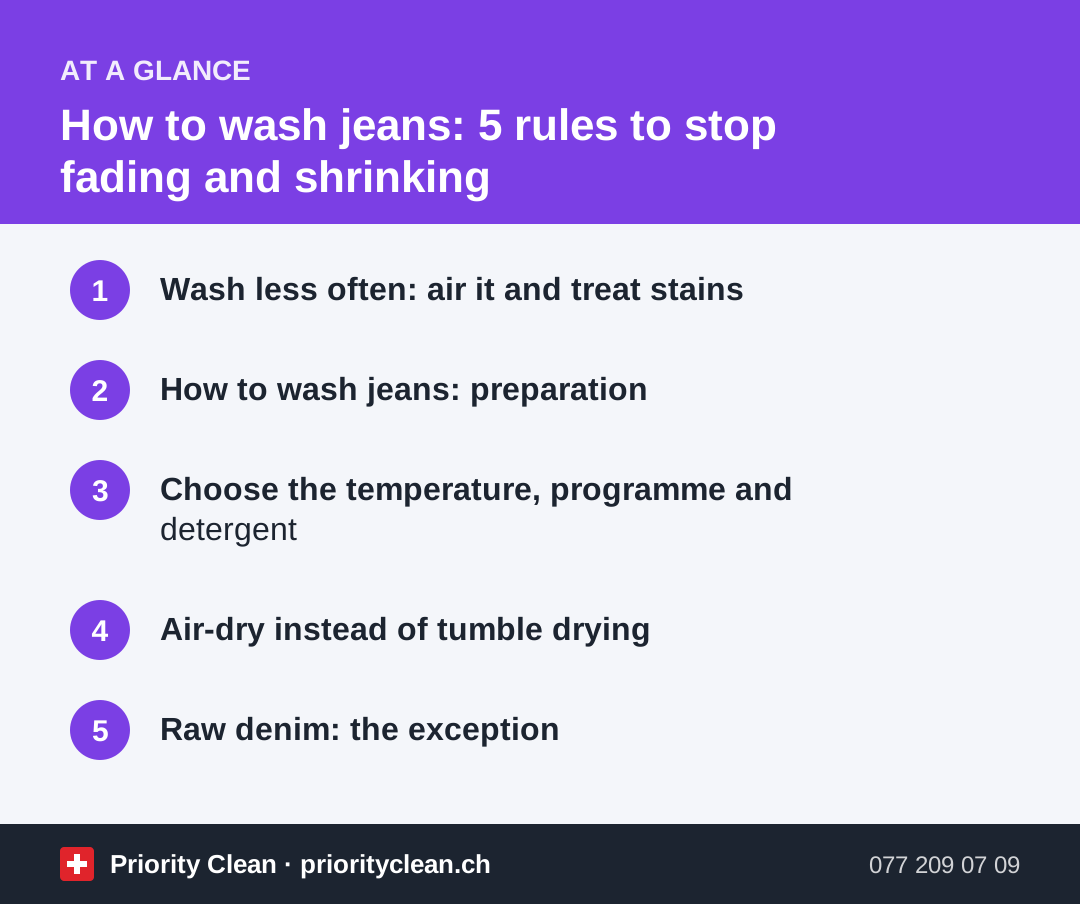
1. Wash less often: air it and treat stains
The most important rule is also the simplest: only put your denim in the machine when it's really dirty or smells. After a day at the office, airing it overnight on the balcony or by an open window is usually enough.
Treat individual stains directly: dab them with a damp cloth and a little colour detergent, without rubbing. If your cycle ride has left chain oil on the hem, see our guide to removing chain oil stains. Every cycle you skip protects the colour and saves water and electricity.
2. How to wash jeans: preparation
A few quick steps before loading make the biggest difference:
- Empty the pockets: a forgotten tissue spreads as lint all over the drum.
- Turn them inside out: the friction then hits the inside, and the colour on the outside stays rich for longer.
- Close buttons and zip: open zip teeth and rivets can damage other laundry and the drum.
- Sort by colour: dark denim with dark laundry, light denim with light colours.
- Wash a new pair separately: strongly dyed denim still releases colour in the first few cycles.
3. Choose the temperature, programme and detergent
Start by checking the care label. According to GINETEX, the number in the tub is the maximum temperature, and bars underneath call for a gentler programme. For most denim, much less than the stated value is enough.
| Type | Temperature | Programme and detergent |
|---|---|---|
| Dark cotton denim | cold to 30 °C | Colours or easy-care, dark-wash or colour detergent |
| Light denim | 30 °C, 40 °C if the label allows | Colours, colour detergent |
| Stretch denim with elastane | cold to 30 °C | Easy-care, low spin speed |
| White denim | per label | Separately or with white laundry |
The Swiss energy programme EnergieSchweiz advises choosing low temperatures of 20 to 30 °C and eco programmes, without increasing the detergent dose at low temperatures. That is exactly what protects denim, too.
Avoid heavy-duty detergent with bleach: it lightens dark colours. Fabric softener isn't needed. Spin at a medium speed, or a low one for stretch.
4. Air-dry instead of tumble drying
Alongside temperature, the tumble dryer is the main reason for shrunken denim. So hang the trousers by the waistband or the legs, smooth the seams and let them dry in the air – dark pairs ideally out of blazing sun.
Thick denim takes a little longer to dry. In the shared laundry or drying room that's no problem; in the flat, make sure to air the room well. Once dry, give the waistband and legs a quick tug back into shape. They rarely need ironing.
5. Raw denim: the exception
Raw denim – unwashed, untreated denim – comes out of the shop stiff and very dark. Many enthusiasts wear it unwashed for a long time so that a personal wear pattern develops at the knees and pockets. Whether and when you wash it is a matter of taste – above all, follow the manufacturer's advice.
- If the fabric isn't pre-shrunk, it can shrink considerably the first time it touches water. So pay attention to the manufacturer's sizing advice.
- For the first wash, a cold hand wash inside out – in the bathtub, for example – with a little delicates detergent works well.
- Raw denim bleeds heavily. Always wash it on its own, and be careful with light seat covers or bags in the first few weeks.
The most common mistakes
- Into the machine after every wear: the denim fades without looking any cleaner.
- With towels and whites: terry cloth rubs, and a new pair stains light laundry.
- Hot washes "for hygiene": for everyday denim this isn't necessary and damages colour and elastane.
- Tumble drying to save time: the trousers shrink and the stretch loses its spring.
Frequently asked questions
How often should you wash jeans?
There's no fixed rule. Wash them when they're visibly dirty, smell or have lost their shape. In between, airing and spot-treating stains is enough. The less often they go in the machine, the longer the colour lasts.
What temperature should jeans be washed at?
For most pairs, cold to 30 °C is enough, even if the label would allow more. Light denim can be washed a little warmer if needed, according to the label. Stretch denim with elastane is best kept cool.
Why wash jeans inside out?
Because the friction in the drum then hits the inside. The indigo on the outside is rubbed off less, and fewer pale streaks form along seams and edges.
What can I do if my jeans have shrunk?
A slightly shrunken pair often stretches out a little as you wear it. You'll find tips on careful stretching in our guide on clothes that have shrunk. There's no guarantee, though, that they'll return to their original size.
Thanks for your feedback! Feel free to share the guide.
Thanks! What was missing? Drop us a line – we will improve the guide. WhatsApp